
Why You're Suddenly Mouth Breathing at Night (and how to fix that)
Sep 10, 2026
So many of you wake up with a dry mouth, a sore throat, or that special kind of morning breath that shows up before your actual morning breath, and just chalk it up to getting older. Maybe your partner's mentioned the snoring too — more of it, louder than it used to be. Maybe you've caught yourself in a candid photo with your jaw hanging slightly open and thought, huh, when did that become my resting face?
Here's the part nobody explains: none of that is random. You're breathing through your mouth all night instead of your nose, and that switch has a specific hormonal cause — plus consequences that reach a lot further than chapped lips. Your face. Your teeth. Your brain. Your heart. All of it, quietly, every single night you don't address this.
Wait — Why Would I Suddenly Switch to Mouth Breathing?
Progesterone and estrogen do more than run your cycle and your mood. Progesterone keeps the muscles of your upper airway firm, and it stimulates the part of your brain that drives your breathing. Estrogen reduces inflammation in that same airway and keeps your nasal passages clear. When both decline through perimenopause and menopause, the muscles at the back of your throat lose tone the same way muscle everywhere else in your body does when the hormonal support behind it disappears. A looser throat collapses more easily during sleep. Your nose gets more congested. And your body, doing the only thing it can do when the nose isn't cooperating, switches you over to mouth breathing at night — whether you're aware of it or not.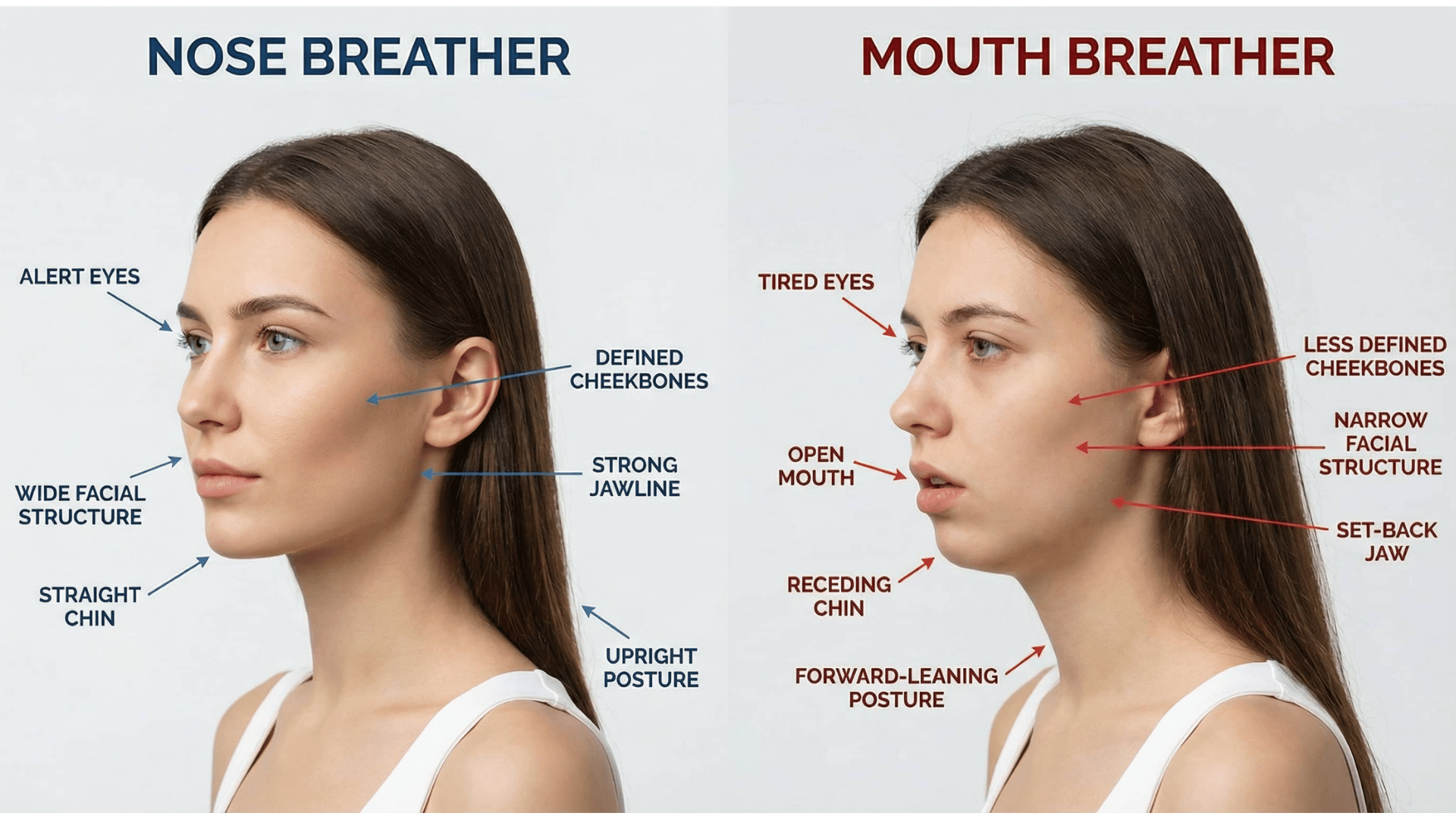
This Isn't a Dry-Lips Problem
Most of you are filing "I've been a mouth breather my whole life" under harmless. It's not. So let's go through it? Because mouth breathing impacts your face, your mouth & teeth, your cognitive ability, your heart & your lifespan.
Your Face
This is the one nobody warns you about, and it's not just vanity. Mouth breathers tend to develop a recognizable look — orthodontists literally call it "long face syndrome" — because your tongue is supposed to rest against the roof of your mouth all day and night, and that constant, gentle pressure is part of what holds your midface and jaw forward. Drop your tongue to the floor of your mouth instead, which is exactly what mouth breathing does, and that support disappears. The most dramatic version of this shows up in kids and teens, whose bones are still actively growing around whatever pressure — or lack of it — they're getting. In adults, your skeleton has settled, but your soft tissue hasn't: years of sleeping with your jaw slack and your mouth open shows up as sagging along the jawline and a face that reads older than it should, on top of whatever slow bone-level change is still happening underneath. Either way, "it's just how I sleep" is doing more to your face than you think.
Your Mouth
Saliva does constant, quiet work all night — neutralizing acid, washing away bacteria, protecting your enamel. Breathe through your mouth for eight hours and that saliva evaporates, turning your mouth into exactly the dry, low-defense environment decay-causing bacteria love. It's biting, but true: there's a documented uptick in dental cavities, gum disease and root canals for women as they enter menopause (speaking from experience, here; I had no dental issues for 20+ years, but this year I've had 2 root canals). More mouth breathing equals more bacteria equals more cavities, more gum inflammation, and more trips to the dentist. Yeowch.
Your Brain
Mouth breathing at night is frequently a sign of the same airway instability behind sleep-disordered breathing and sleep apnea, and the research connecting that to cognition is not subtle. A study of more than 18,500 adults over fifty found that women with known or suspected sleep apnea were more likely than men — at every single age — to be diagnosed with dementia, and the gap between women and men only widened as they got older. Researchers point to a few overlapping reasons: fragmented sleep drives inflammation in the brain, cardiovascular strain compounds it, and declining estrogen appears to make women's brains more vulnerable to all of it at once.
Your Heart (And a Host of Others)
Airway instability during sleep means your oxygen dips repeatedly through the night, and your cardiovascular system responds the way it responds to any repeated stress: elevated blood pressure, more strain on your heart, and a well-documented link to higher rates of type 2 diabetes, stroke, and metabolic syndrome. This isn't just a snoring problem — it's a whole-body inflammatory event happening while you're asleep.
Your Lifespan
Here's a number worth reading twice. Research on people with severe, untreated sleep apnea — not mild, not "sometimes I snore," but severe — found they were dying at over three times the rate of people without it, a number that climbed even higher once researchers accounted for the people who were actually using treatment like CPAP. That's pretty damning evidence about the significance of mouth breathing and its related illnesses.
Most of you reading this aren't in "severe untreated sleep apnea" territory. But mouth breathing is very often the visible tip of that iceberg, the thing your partner notices before a doctor ever gets involved. You can either treat this now, while it's still a hormone problem and a habit problem, or wait until it's a cardiologist's problem, or a neurologist's problem. Your choice, but only one of those is still cheap and easy to fix.
What You Can Actually Do About It
The GREAT news: like so many things in life, this is fixable, and it happens in two parts, in this specific order — strengthen the muscle first, then use mouth tape to lock the new habit in while it rebuilds. Let's get into it and help you reclaim your nasal breathing.
Part One: Strengthen the Muscle
The real fix has a name — myofunctional therapy, or oropharyngeal exercise if you want the clinical version. It's throat and tongue training, and it's the closest thing your airway has to a strength program.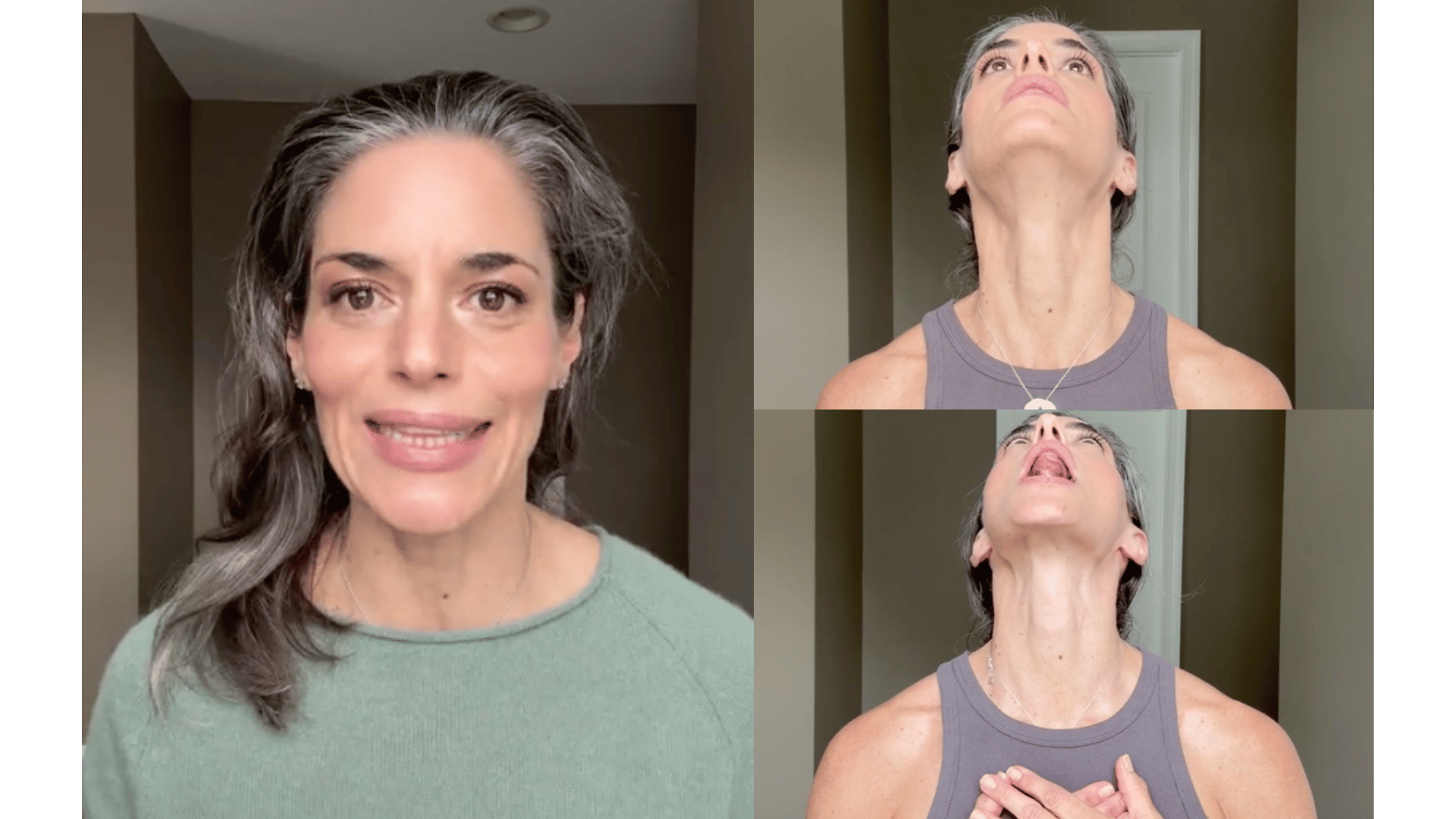
And the research backs it up. One meta-analysis pooling over a hundred adults found these exercises cut the average number of breathing disruptions per hour roughly in half, dropped snoring during actual sleep from 14% of the night down to under 4%, and pulled daytime sleepiness scores down from borderline-dangerous to normal. For mild-to-moderate snoring and sleep-disordered breathing — which is most of you reading this — that's a real number, not a vibe. (For moderate-to-severe sleep apnea, this becomes a companion to CPAP or whatever else your doctor has you on, not a replacement for it.) In other words: if you're waking in the middle of the night with a dry throat, try these first before panicking or giving up. They take literally 3 minutes to do and you can do these while watching TV or scrolling.
Three exercises, done daily, are doing almost all of the work in the research:
The Tongue Suction Hold. Flatten your whole tongue and suction it up against the roof of your mouth, like you're holding a vacuum seal (this is otherwise known as "Mewing" for all you facial exercise baddies). Hold five to ten seconds, release, ten reps. This retrains your resting tongue posture — where your tongue lives all day and all night without you thinking about it — which is our ultimate goal and to be honest, matters more than anything else on this list.
The Tongue Slide. Tip of your tongue right behind your top front teeth, then slide it straight back along your palate as far as it'll go, like you're painting a stripe down the roof of your mouth. Ten slow reps. This is the actual strength work, on the exact muscle that's supposed to hold your airway open at night instead of collapsing into it.
The Hum and Hold. Breathe in, then hum loud and long on one note until you're out of air. Feel it buzzing in the back of your throat and up into your soft palate. Five rounds. This is the part of your throat that flutters when you snore, and it's the one everybody skips.
Three minutes a day. Three months. That's the floor. Nobody's throat gets stronger from doing this twice and quitting, so stop resisting, just commit to this and set a daily timer on your phone as a reminder and crank these out, and then get back to your normal life.
Part Two: Force the Nasal Habit (Mouth Tape, Done Right)
Let's talk about mouth tape, because it's an inexpensive and powerful tool to get you breathing nasally at night, which is what we're after (the more you breathe through your nose 24/7, the greater the health benefits). I know mouth tape is trendy with the bio-hacking bros, but the science on this supports the trend, so it's worth looking into.
Once you're a few weeks into the exercises and your nose is doing its job better, start incorporating mouth tape into your daily routine. I said what I said! This is such an inexpensive and effective way to condition nasal breathing. Here's the protocol: Find a tape you like online (there are a few hundred available on Amazon), and note that you might need to go through a few to find one you really like that feels comfortable (note: like nothing). Start with ten minutes at your desk in the daytime, and see how breathing through your nose feels. If you notice it — to the point that nasal breathing is uncomfortable — make a note that you're likely breathing more through your mouth in the daytime, and that you want to shift that to nasal breathing, so that's something to work on. Graduate from 10 minutes to 15. Then 20. And so on. If you don't notice it, that's what we're after. Extend the time. Keep extending it, until you're ready to try mouth taping at night.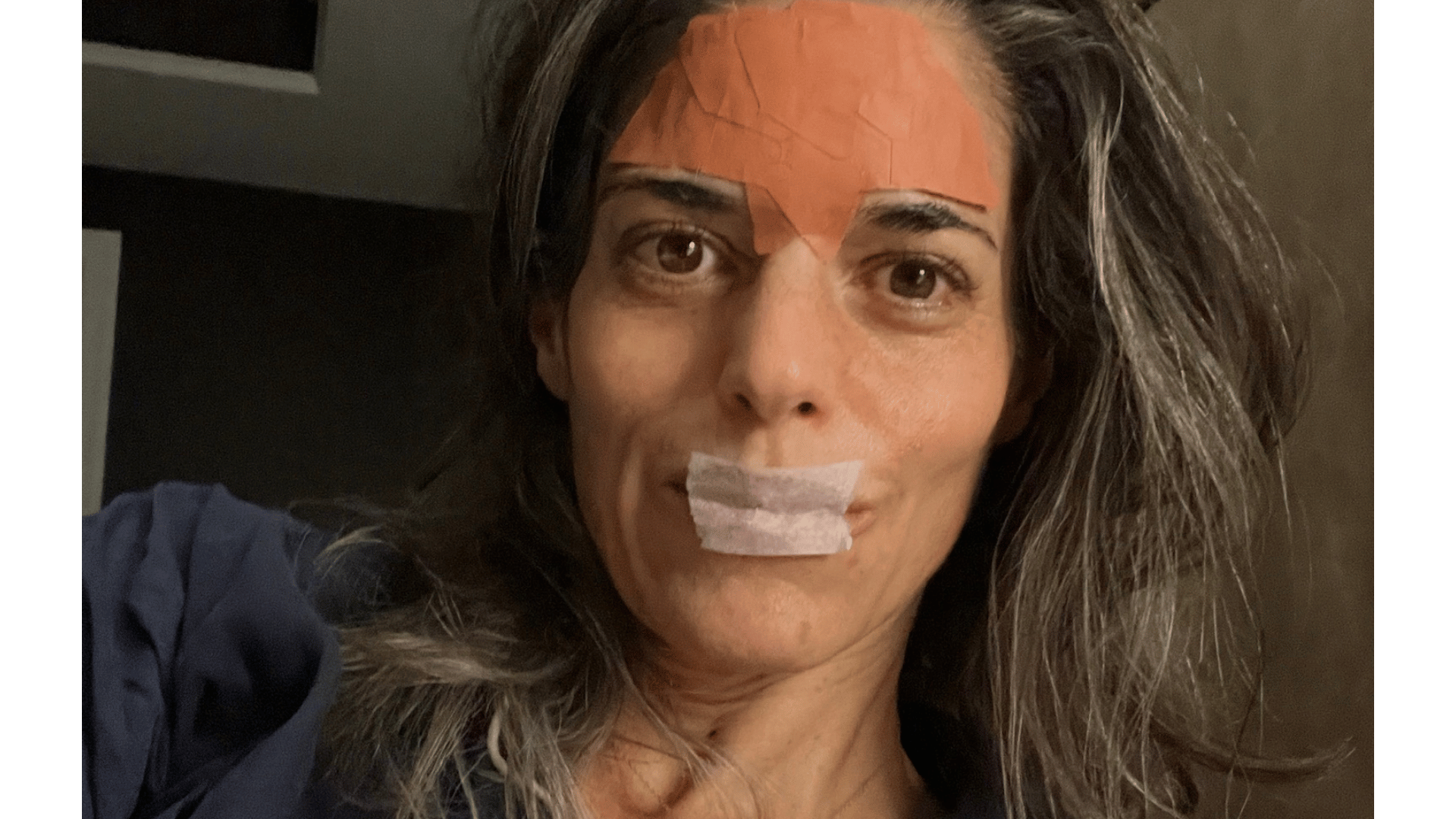
Give yourself grace here; the tape takes some getting used to, so if you put it on and you can't fall asleep right away, be patient and work with yourself on this. Again, you might need to try a few different mouth tapes before you settle on one you "love" -e.g., can't really feel (I tried a whole bunch and couldn't get comfortable with tape that covered my entire mouth, so I just use a small piece of surgical tape, about 1.5" in length, just enough to keep my lips closed, but the open sides keep me from feeling out of control). Mouth tape is enough of a cue to keep you breathing nasally overnight while the muscle underneath finishes rebuilding, so the new habit sticks instead of sliding back into mouth breathing the second you're not thinking about it.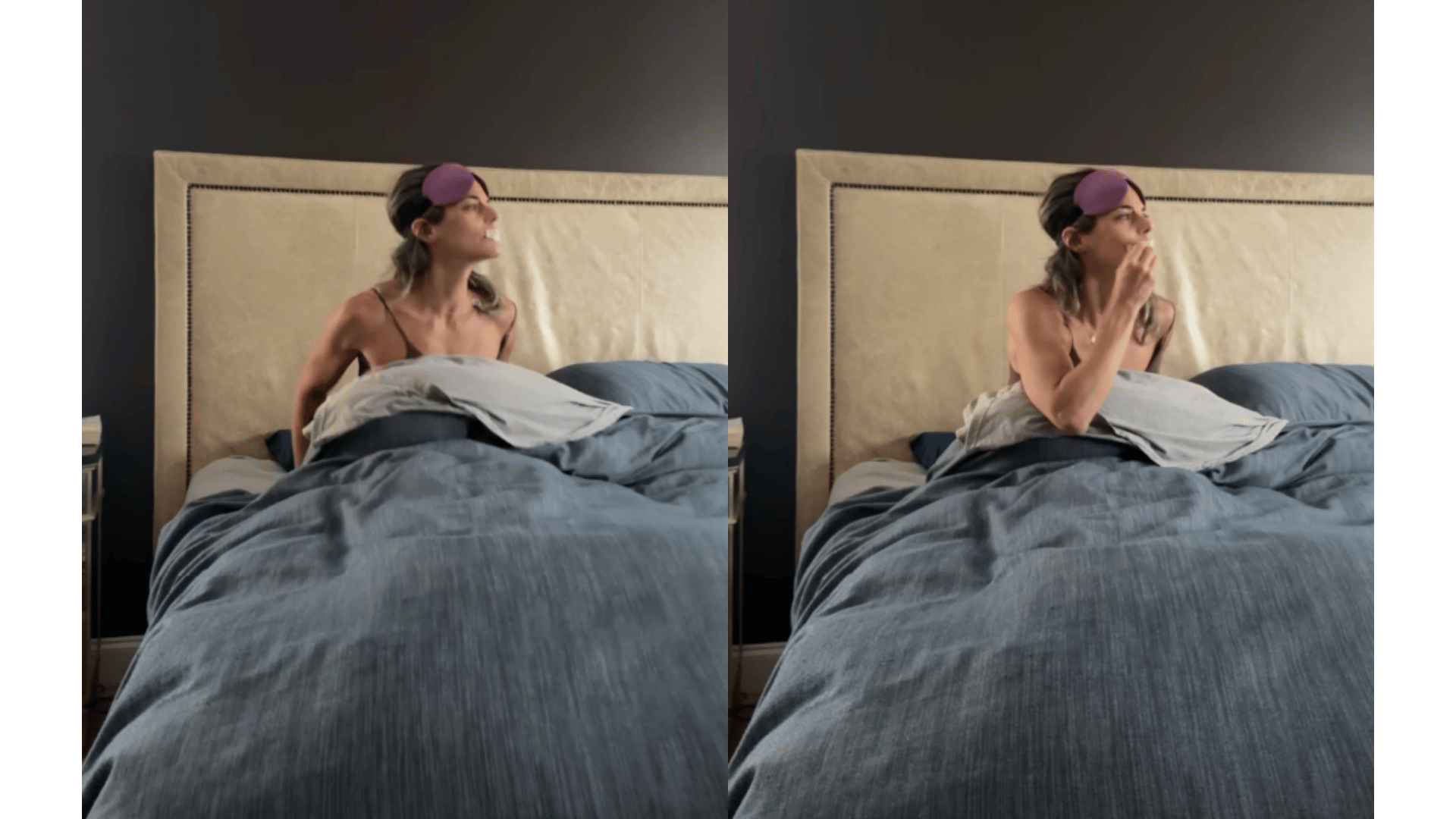
However you come out on mouth tape (for it, or against it): here's the floor, and I'm not negotiating on it. If you snore loudly, if you or your partner have ever noticed you gasping or choking in your sleep, or you wake up exhausted no matter how many hours you got — that's not a tape problem, that's a talk-to-your-doctor-about-a-sleep-study problem. Tape is also the wrong first move here, and possibly a dangerous one. The goal is to restrict mouth breathing, not breathing, period. If your nose is congested, skip the tape, full stop. Test your mouth tape while you're awake and calm before you ever try it asleep. Start with a porous tape, never anything that fully seals your mouth. And treat it as reinforcement for an airway you're actively rebuilding — not a fix for one that's already blocked.
Putting It Together
You can either do the exercises and let tape lock in the progress, or skip the exercises and just tape over the problem and hope your throat muscles get stronger by the power of positive thinking. One of those gets you a stronger throat, a clearer face, a sharper brain, and a heart that isn't working overtime while you sleep. Fabulous.
Muscle first, tape second, three months of actually showing up for both. That's the whole system.
If you found this blog post educational, wonderful. As a content creator, I aim to share about alllllll the things that are going to help you thrive in midlife, not just diet & exercise. I built my Aging Well Naturally Masterclass because I kept watching women fix their diet and fix their workouts and still feel like they were falling apart at night — because nobody was looking at connecting the dots and what was happening to other systems in the body (like hormones; or sleep; or airways - and how they all interconnect). My Masterclass is a holistic and comprehensive deep dive into women's health in midlife (mindset; nutrition; strength training; mobility; sleep; stress; hormones; and more) and we build real protocols to help you course correct. So you're not just surviving; you're actually thriving in midlife & beyond.
If you want more than just symptoms patching, join the Aging Well Naturally Masterclass Waitlist you'll be the first to know the moment enrollment opens, plus get first access to any early-bird pricing or bonuses.
x Juliana
Author